Why Do We Source Our Wood From Indonesia?
Home/ Why Do We Source Our Wood From Indonesia?
Home/ Why Do We Source Our Wood From Indonesia?
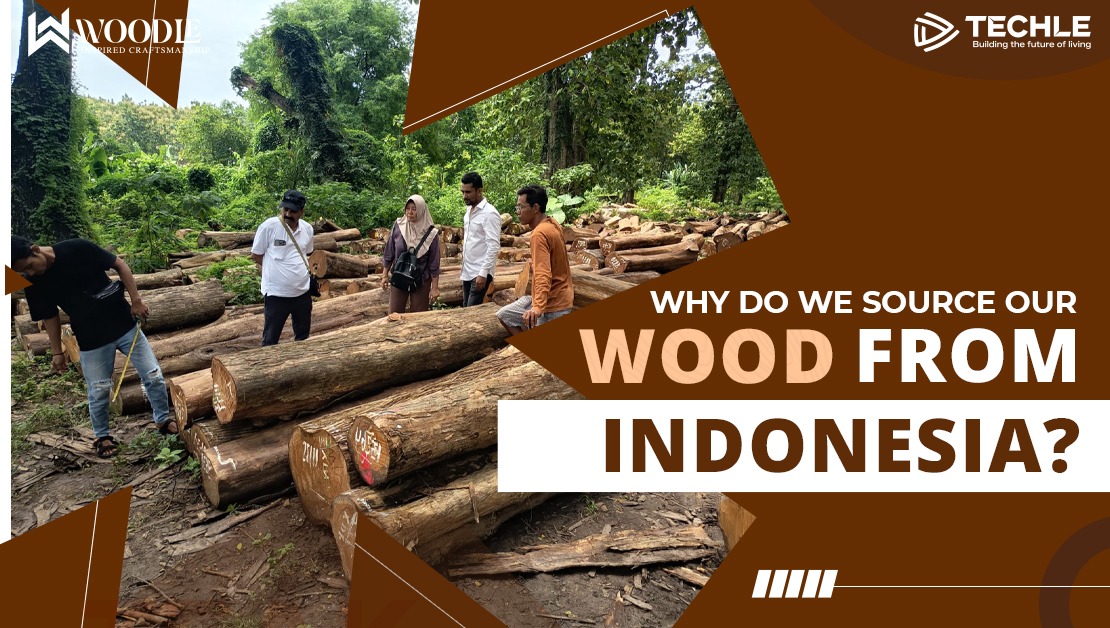
Why did we choose Indonesia over every other country for our wood?
It's a question we get a lot, and it deserves a real answer, not just a marketing line. When we started building wooden cottages, we knew the wood itself would decide whether these homes would actually last or just look good for a few years. So before we committed to a source, we looked closely at what different countries could offer, the species available, how the timber was regulated, and how consistent the quality actually was.
Indonesia stood out for its unique combination of high-quality timber and a dependable legal system. Hardwood species that are naturally built to last, and a legal system strict enough to verify exactly where every piece of wood came from. That combination is tougher to find than people usually think. In this blog, we're breaking down exactly why we chose Indonesia, what makes its timber different, and why we think it was the right call for the homes we build.
Indonesia's relationship with wood didn't begin as an export strategy. It began as a craft for generations of families in Central Java, particularly around the Jepara region, who grew up carving, joining, and shaping timber the way other families pass down farming or fishing. Wood wasn't just a material there; it was a livelihood stitched into the local identity, refined over centuries into a level of joinery and finishing skill that's genuinely difficult to replicate anywhere else.
That craft base is what eventually put Indonesia on the global timber map. As demand for tropical hardwood grew internationally, this deep well of woodworking expertise gave Indonesian timber a reputation that raw material alone couldn't have earned. Buyers weren't just purchasing wood; they were purchasing generations of know-how in how to work it.
But heritage alone doesn't guarantee responsible sourcing, and the industry knew it. Over time, informal trade practices gave way to a more structured, regulated approach to forestry, one built specifically to answer a simple but critical question: is this timber actually legal? That question is what eventually led to SVLK-certified wood, Indonesia's formal Timber Legality Assurance System, becoming the backbone of how serious buyers like us source today.
The craft didn't disappear as the industry modernised. It became the foundation for building the modern regulatory system. That's the version of Indonesian wood sourcing we use.
Indonesia remains one of the world's major producers of tropical hardwood, and demand hasn't slowed down; if anything, it's tightening. Indonesian timber for construction, furniture, and hospitality projects continues to move across Europe, the Middle East, the US, and increasingly across Asian domestic markets, including India, where interest in sustainable timber sourcing India relies on has grown alongside the boom in resorts, villas, and prefab housing.
What's changed is how that demand gets fulfilled. SVLK certification has gone from a nice-to-have to something close to a market requirement. International buyers and increasingly domestic ones simply won't commit to timber they can't trace. That change has created real challenges for supply: there is a limited amount of certified, high-quality wood, skilled workshops are located in certain areas, and the hospitality and resort industry is using more and more of the best materials available.
This is precisely the environment where sourcing discipline stops being a compliance checkbox and starts being a genuine competitive differentiator. When good, legal, well-processed timber is harder to secure, how you secure it and who you're buying it from starts to matter enormously.
Not all Indonesian hardwood behaves the same way, and part of building well is knowing which species belongs where. Here's the palette of Indonesian hardwood species that goes into our structures and interiors:
Mahogany is the steady, dependable one, a fine, even grain with strong dimensional stability, which is why it's our go-to for interior walls, ceilings, and furniture-grade surfaces where consistency matters more than raw toughness.
Merbau, sometimes called the ironwood of the group, is dense and naturally rich in oils that resist decay and pests on their own. It's the species we lean on for structural framing and outdoor-facing components that need to hold up under sustained load and weather.
Meranti is lighter and more dimensionally stable than it looks, making it well-suited for modular wall panels and components where consistent behaviour across many pieces matters more than sheer density.
Bangkirai is a heavy, dense hardwood that performs particularly well in high-moisture conditions, which is why it ends up in load-bearing pillars and structures exposed to sustained damp or poolside environments.
Teak rounds out the group as the long-standing benchmark, naturally weather-resistant, prized for holding up to harsh elements over decades without losing structural integrity. It's the species most people already associate with quality Indonesian hardwood, and for good reason.
Each of these species earns its place for a specific structural or aesthetic job; we're not choosing based on appearance alone but on what each species is actually engineered by nature to do well.
This is the real question behind the question. It's not just "Why Indonesia?" It's "Why should you trust our Indonesian sourcing?"
The honest answer starts with something most companies in this space don't do: we source our SVLK-certified wood directly from legal entities in Indonesia, not through intermediaries, distributors, or supplier networks. That distinction matters more than it might sound. Every hand-off in a supply chain dilutes traceability, muddies documentation, and quietly turns 'legal' into 'probably legal'. By going straight to the source, we keep the chain of custody short, direct, and verifiable; there's no ambiguous middle step where we're trusting someone else's paperwork instead of our own.
SVLK itself isn't a marketing badge to us; it's the actual backbone of how we verify legality. It confirms that timber has been harvested from certified, legally managed forests and can be traced back through the supply chain. That's the same standard the global market has converged on, and it's the standard we hold every shipment to before it ever reaches our facility.
Sourcing responsibly is only half the job, though; what happens to that timber afterwards is what actually determines whether it becomes a home that lasts. Once verified and sourced, every piece goes through our 5-Stage Wood Fortification Process: precision sawing to exact dimensions, vacuum pressure and chemical treatment to eliminate hidden pests and build in long-term protection, industrial kiln drying that reduces moisture content to a stable 8-12%, and final component processing into the doors, panels, and flooring that actually reach your site. Responsible sourcing and durable building aren't two separate promises for us; they're the same discipline applied at different stages.
There's also the matter of proximity. Our manufacturing facility sits in Jepara, in the same region this sourcing and craft tradition comes from, which means quality control isn't happening at a distance from where the timber originates. The people verifying, processing, and fabricating the wood are working within the same ecosystem it was grown in.
Put together, that means the timber in your home has taken a shorter, more accountable journey – from a certified Indonesian forest through a facility in the same region into a component built to a specific engineering standard – than most alternatives on the market today.
Sourcing responsibly and building well aren't two different values for us; they're the same decision, made consistently at every stage, from the forest floor to the final joint. That's not a claim we're asking you to accept without evidence. It's something you can see for yourself.
If you'd like to see the actual materials, the grain, the finish, and the components that come out of this process, our Experience Centre in Devanahalli, Bengaluru, is open for exactly that. Walk through it, ask us anything about where a specific piece of timber came from, and we'll tell you.