Surface-Treated vs. Deep Chemical-Treated Wood: The Difference That Lasts 50+ Years
Home/ Surface-Treated vs. Deep Chemical-Treated Wood: The Difference That Lasts 50+ Years
Home/ Surface-Treated vs. Deep Chemical-Treated Wood: The Difference That Lasts 50+ Years
Although "termite-proof" is a common phrase in Indian wood sales, it is misleading because almost nobody explains its actual coverage.
Here's how it usually plays out: a deck, a set of outdoor chairs, a wooden home, a glossy finish, beautiful wood, and the word "treated" tucked somewhere into the pitch. Two or three monsoons later, the joints are cracking, the varnish is peeling in sheets, and small holes are showing up near the base of a leg or beam.
The wood was treated, just not in the way that actually matters.
The real gap is this: treating wood's surface is not the same as treating it all the way through. One buys a few good-looking years. The other is designed to last decades, and knowing which one you have can save you from redoing floors, furniture, or entire structures far sooner than necessary.
Most wood used in furniture, decking, and structural beams has an exterior treatment, such as paint, varnish, polish, or a basic protective oil. These coatings do a real job. They add shine, even out the colour, and slow down how quickly the wood absorbs moisture from the air.
But here's the catch: none of that changes what's happening inside the wood.
The coating sits on top of the fibre like a raincoat. It doesn't stop moisture that's already trapped inside from expanding and contracting with every change in humidity. The coating also fails to reach hidden insect larvae that may already be inside the timber, even before it was ever applied. The untreated wood underneath is exposed again the moment the coating wears down from foot traffic, sun exposure, rain, or routine cleaning, as if nothing had ever been done to protect it.
This is precisely why surface-treated wood tends to follow a familiar pattern: it looks fine for the first year or two, and then the real issues start showing up. Cracking. Warping. Small holes that mean termites got in long before anyone noticed. It's not that the wood was "bad". The issue is that the protection it received never penetrated deeper than the paint.
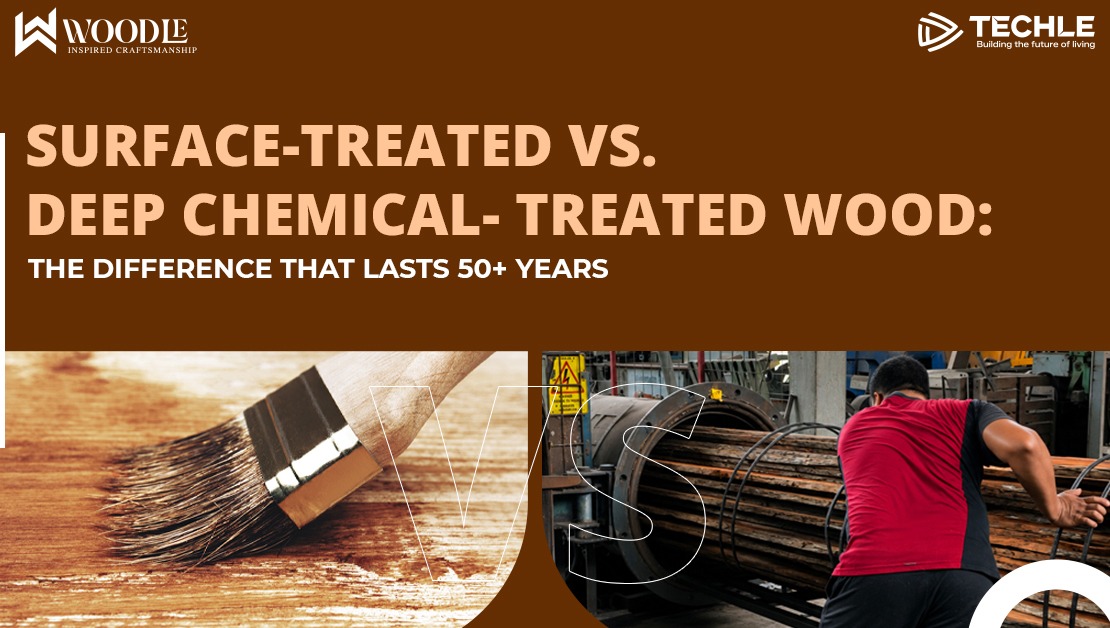
Deep chemical treatment works from the opposite direction; instead of coating the outside, it changes the wood from the inside.
The process typically involves placing the wood in a vacuum chamber. The vacuum draws existing moisture out of the wood fibres. While the wood is in that open, receptive state, protective chemical agents are forced deep into the fibre structure, driven into the grain itself rather than brushed onto the surface. This process reaches spaces a surface coating never could, including hidden larvae that might already be present inside the timber, and it creates a barrier that exists throughout the wood, not just on its outer face.
The practical difference is simple: there's no longer a single outer layer that, once breached, leaves the rest of the wood defenceless. The protection isn't a layer at all; it's part of the material now.
This is the same stage that appears consistently across every wood product built this way, whether it's a dining table, a bathroom vanity, a deck tile, or a structural wall panel. It isn't a special add-on for one product line. It's simply the standard the wood goes through before it becomes anything at all.
Deep chemical treatment solves one half of the problem: biological damage from pests and rot. But it doesn't solve the other half on its own, which is physical damage: warping, shrinking, cracking, and the gaps that slowly appear between floorboards or panels over time.
That second half is about moisture content, and it's addressed through controlled, industrial kiln drying, a slow, precise process that typically runs 10 to 15 days and brings the wood's internal moisture down to a stable, low range (around 8–12%, depending on the specific application).
Moisture problems actually cause many issues that people attribute to "defective" wood. Wood that hasn't been properly dried still has movement left in it; it will keep shrinking and expanding as it settles into its environment, especially in air-conditioned rooms or humid coastal air. No amount of chemical protection will change that. The wood needs to be brought down to a stable moisture level before it's ever installed, or it will keep moving no matter how well it was otherwise treated.
The two processes are not interchangeable; each addresses a different problem, and both are necessary.
Deep chemical treatment stops biological damage: termites, borers, and fungal rot.
Controlled kiln drying stops physical damage: warping, shrinking, cracking, and gaps.
Wood treated with only one of these methods is only half-protected, even if it looks fine on day one.
| Features | Surface-Treated Wood | Deep Chemical-Treated Wood |
| Where protection sits | On the outer coating only | Throughout the wood fibre |
| Pest resistance | Limited larvae already inside are untouched. | Larvae eliminated at the source; ongoing resistance |
| Moisture stability | Depends entirely on the coating staying intact | Wood is dried and stabilised internally before finishing. |
| Maintenance | Needs recoating every 1–2 years to stay protective | Protection doesn't wear off the way a coating does. |
| What happens as the coating wears | The wood underneath is exposed again. | No "underneath" to expose; protection isn't a layer |
| Typical lifespan | Shortened by recurring exposure once coating fails | Built for multi-decade use |
The gap between these two approaches isn't theoretical; it shows up fastest in the applications that put wood under the most stress.
Outdoor decking and pergolas deal with direct sun, standing monsoon water, and constant temperature swings. A surface coating on outdoor wood has the hardest job of all, because UV exposure alone degrades varnish and paint faster than almost anything else. Wood that's protected from within doesn't depend on that coating holding up season after season.
Bathroom amenities – vanities, washbasins, and tubs – are in a near-constant humid environment. Surface coatings in bathrooms are especially prone to failing quietly, because steam finds its way into hairline cracks in the finish long before anything looks visibly wrong. Deep-treated wood in wet areas is built to handle that humidity as a baseline condition, not an exception.
Furniture in air-conditioned interiors faces the opposite problem: repeated humidity drops that cause standard wood to crack. This is one of the most common furniture complaints, and it's almost always a moisture-stability issue rather than a treatment issue, which is precisely why the drying stage matters as much as the chemical treatment.
Structural wall panels and flooring must hold their exact shape for the wood to remain flush against adjoining components for years. Any residual movement in the wood from incomplete drying eventually shows up as gaps, creaks, or misalignment, regardless of how attractive the surface looks on installation day.
Whether you're evaluating a wooden home, a set of furniture, or an outdoor deck from any manufacturer, not just one, a few questions will tell you almost everything you need to know about how serious the treatment actually is:
Does the protection go into the wood fibre, or is it just a coating on the surface?
What moisture content was the wood dried to before it was finished?
How was pest resistance achieved, and does it reach material that's already inside the wood, or only what's exposed?
If a seller can answer these clearly, with specifics, that's usually a reassuring sign. If the answer remains vague, just saying "It's treated" or "It's termite-proof" without explaining how, then it's worth pausing.
The above is precisely the checklist that Techle's 5-stage wood fortification process was built to answer, stage by stage:
Stage 1 — Sourcing: SVLK-certified timber, sourced directly from legal Indonesian entities.
Stage 2 — Sawing: Logs cut to exact, uniform dimensions.
Stage 3 — Vacuum Pressure & Chemical Treatment: In the deep treatment stage described above, moisture is drawn out, and protective agents are forced into the fibres.
Stage 4 — Industrial Kiln Drying (10–15 days): Moisture content is brought down to a stable, low range for lasting dimensional stability.
Stage 5 — Final Component Processing: The stabilised wood is shaped into finished flooring, panels, furniture, and structural components.
None of these stages work in isolation; the deep treatment and the drying stage, in particular, are what separate wood that needs constant attention from wood that's built to be left alone for decades. This is the process behind every product across the range, from a single dining table to an entire home.
It's one thing to read about the difference between a coating and a transformation. It's another to actually run your hand across wood that's been treated this way and compare it to something surface-finished.
At Techle Indo Innovation's Experience Centre in Devanahalli, Bengaluru, you can do exactly that: walk through fully assembled wooden and CLT home units, touch the panels, and ask the design team directly about how the material was processed before it ever reached the site.